If you are entertaining a differing site conditions claim, consider this Third District Court of Appeals case from the mid-90s.
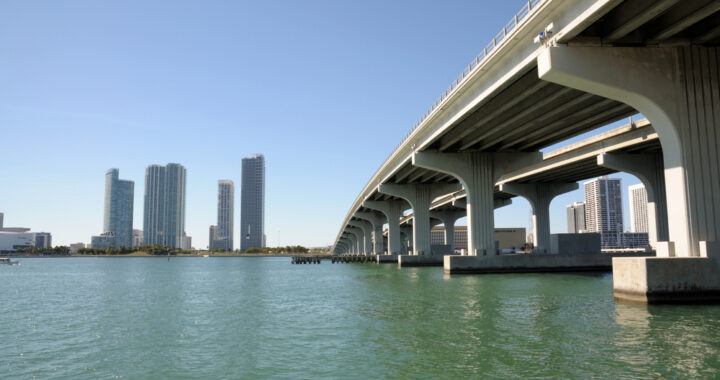
In Hendry Corp. v. Metropolitan Dade County, 648 So.2d 140 (Fla. 3d DCA 1995), a contractor was hired by Dade County to demolish the old Rickenbacker Causeway in Miami. The original 1941 plans of the causeway were made available to contractors. The lowest bidding contractor that was awarded the project based its bid “on its conclusion that the pilings supporting the old bridge were made of concrete.” Hendry, supra at 141. The contractor based this conclusion on the original plans, its visual observation, and experience.
The contractor did not deliver the project on time as it had problems with its demolition. Dade County withheld contract balance for the delayed completion, and the contractor sued Dade County due to differing site conditions:
Specifically, [the contractor] alleged that after it started work on the project, it encountered two differing site conditions that required an equitable adjustment of the contract price. The first differing site condition alleged was the existence of wooden, rather than concrete pilings. [The contractor] contended that Dade County had an obligation to provide the bidders with the 1941 specifications for the bascule which would have shown the pilings were wooden. Demolition of structures supported by wood pilings is more difficult than demolition of structures supported by concrete pilings. The second differing site condition that [the contractor] alleged made demolition more difficult and therefore more expensive was subsurface debris that remained from the original construction project. [The contractor] claimed that Dade County was aware of the debris but failed to notify the bidders.
Hendry, supra, at 141.
The contractor wanted the trial court, as well as the appellate court, “to impose upon Dade County a duty heretofore not recognized in Florida—that Dade County had an obligation to disclose facts in its possession when its superior knowledge or silence would convey a false impression, even when it made no affirmative representation.” Hendry, supra at 141.
Here’s the issue: did the owner / public body have a duty to make such an affirmative representation? NOPE.
The law in Florida also provides that where a contractor is misled by relying on inaccurate representations, a disclaimer clause requiring inspection of the site will not prevent the contractor from recovering additional costs under a differing site conditions clause. However, a differing site conditions clause will be “triggered only where an inaccurate representation is relied on, not where there has been no representation.” Moreover, in the absence of such misrepresentation, there will be no recovery under the differing site conditions clause if the contractor relies on its own inadequate investigation.
Hendry, supra, at 142 (internal citations omitted).
Here, Dade County made no affirmative representation and did not represent any inaccurate fact.
As to the contractor’s first differing site condition claim: “Although Dade County did not provide the 1941 specifications for the bascule, which indicated that the bridge was supported by wooded rather than concrete pilings, there is no evidence in the record that Dade County withheld the 1941 specifications from [the contractor].” Hendry, supra, at 142.
As to the contractor’s second differing site condition claim: “Dade County made no representations in the bid documents regarding the condition of the bay bottom. … Moreover, there was substantial competent evidence presented at trial that [the contractor] knew, or should have known, that it would encounter subsurface debris.” Hendry, supra, at 143.
Please contact David Adelstein at dadelstein@gmail.com or (954) 361-4720 if you have questions or would like more information regarding this article. You can follow David Adelstein on Twitter @DavidAdelstein1.